
What is EDGE Grant?
The new EDGE grant is a consolidated support scheme announced as part of Budget 2026. Rather than SMEs figuring out which grant to apply for their project, Enterprise Singapore is merging three existing grants – Enterprise Development Grant (EDG), Productivity Solutions Grant (PSG), and Market Readiness Assistance (MRA), into a single application framework.
The intent behind the merger is simplification. Today, a company is pursuing a growth initiative, say, implementing a new Enterprise Resource Planning (ERP) system to unify finance, inventory, and operations into one single source of truth, while also preparing to enter a regional market. That company might technically need to draw from two or three separate grants, each with its own rules, categories, and paperwork. EDGE is designed to remove that complication by putting business transformation, productivity adoption, and market expansion support under one roof.
There are three things worth noting:
- EDGE has officially launched on 30 September 2026. Continue reading to find out more details such as funding percentages and eligible project categories.
- EDGE will be open to all businesses, not only SMEs. This marks a shift from the current grants, which are largely SME-focused, suggesting the new scheme may take a broader view of who qualifies for support.
- AFON has pre-approved solutions ready under EDGE.
Are EDG, PSG and MRA still available?
No. New applications under EDG, MRA and PSG are no longer accepted after 30 September 2026. However, applications submitted before that date will continue to be assessed against the requirements of the respective scheme. Ongoing projects will remain unaffected and will continue to receive support through to project completion and claim disbursement.
A few specifics worth knowing about the past schemes:
- EDG supports growth and transformation projects across three pillars – Core Capabilities, Innovation and Productivity, and Market Access. It funds up to 50% of qualifying costs for SMEs. Larger-scale digital transformation projects, including custom or complex ERP implementations tied to a broader business case, generally fall under this grant.
- PSG supports the adoption of pre-approved productivity solutions and equipment, and is typically the more accessible route for SMEs implementing off-the-shelf, pre-qualified ERP or business management software. AFON has two pre-approved solutions: Microsoft Business Central and SAP Business One.
- MRA supports overseas market entry activities, and has been enhanced – SMEs can receive up to 70% support (from 1 April 2026), capped at S$100,000 per company per new market.
Who can apply for EDGE?
The applicant must be a business entity registered in Singapore with at least 30% Singaporean(s) and/or Singapore PR(s) ownership. Other requirements may apply, depending on the supportable activity.
What is the funding level support (e.g. percentage, cap) under EDGE?
SMEs can receive funding support of up to 50%, while non-SMEs can receive up to 30%. For internationalisation and sustainability activities, the support levels are higher: up to 70% for SMEs and up to 50% for non-SMEs. For the grant caps and eligibility criteria that apply to each supportable activity, refer to Enterprise Singapore’s website or BizSG.
Under EDGE, each company can receive up to S$100,000 in grant support across all eligible activities each year. The annual funding period runs from 1 April to 31 March the following year, with the cap resetting every 1 April. Within this overall limit, up to S$30,000 can be allocated to single-function digital solutions, integrated enterprise systems and selected automation activities.
If your business cannot find a suitable activity under EDGE, the SME Centres can provide business advice, relevant toolkits and resources, and referrals to partners. They can also advise you on other government support schemes outside of EDGE.
What are the supportable projects and/or activites under EDGE?
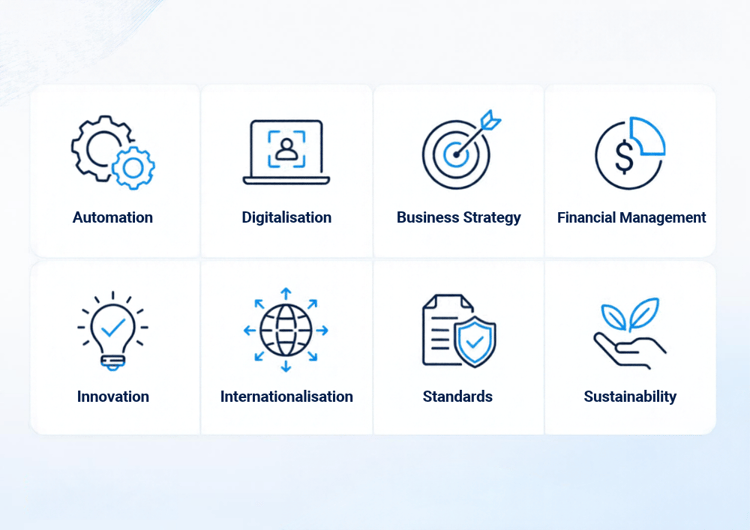
The EDGE Grant covers 8 business areas, and over 150 activities to help your business grow. Whether you're looking to automate your operations, adopt new digital solutions, expand overseas, or build a more sustainable business, EDGE brings all that support under one roof.
Start from what matters most, select the business area most relevant to your priorities: Automation & Digitalisation, Business Strategy, Financial Management, Innovation, Internationalisation, Standards, or Sustainability.
Can a business apply for EDGE if it has previously received funding under EDG, MRA, or PSG?
Yes, businesses that have previously applied for or received funding under EDG, MRA, or PSG can apply for EDGE. Businesses can refer to the Enterprise Singapore's website for the full list of supportable activities under EDGE and submit an application based on their business needs. Businesses should note that EDGE grant support is intended for new projects. If a project has previously received support under EDG, MRA, or PSG, businesses should not be seeking grant support for the same project under EDGE, and are encouraged to direct their grant balance towards new projects instead.
Will my existing EDG, MRA or PSG grant amounts count towards the EDGE grant cap?
No, funding previously received under EDG, MRA or PSG does not count towards your company’s EDGE grant cap. Under EDGE, each company has an annual cap of S$100,000 across all eligible activities, covering the period from 1 April to 31 March the following year. The cap resets every 1 April. Within this overall limit, up to S$30,000 can be used for single-function digital solutions, integrated enterprise systems and selected automation activities.
However, EDGE support is intended for new projects. If a project has already received funding under EDG, MRA or PSG, you should not apply for EDGE support for the same project. Instead, use your available EDGE funding for new eligible projects.
How many grants can a company apply for?
Companies can apply for suitable activities based on their business needs, with a single application submitted for each activity. Total grant support is subject to the annual cap of S$100,000.
Within this overall cap, support for single-function digital solutions, integrated enterprise systems and selected automation activities is limited to S$30,000 per year. This is part of the S$100,000 limit, not an additional allowance.
Support is extended as follows:
- Selected single-function digital solutions & integrated enterprise systems: Limited to one application per UEN
- Pre-scoped equipment: Applicable for multiple locations per UEN
Deployment locations are defined based on postal code. To illustrate, different unit numbers with the same postal code will be deemed as the same deployment location.
Please note that the supportability is subject to further assessment on business use and reasonableness.
What should I do next?
If your business has been using the same system for many years, now is a good time to review whether it meets your operational needs and upcoming compliance requirements. The Inland Revenue Authority of Singapore (IRAS) has announced a phased, mandatory rollout of InvoiceNow for GST-registered businesses, with all such businesses required to implement it by 2031.
AFON offers InvoiceNow-Ready solutions that are pre-approved under the new EDGE grant. Explore how the grant could support your system upgrade, subject to eligibility, and start preparing your business for the InvoiceNow requirements ahead of your applicable deadline.
If your current system or vendor no longer meets your business needs, EDGE can help fund an eligible project to adopt a more suitable solution. AFON brings over 25 years of industry experience and has served more than 600 clients. Our locally based, certified consultants and support team can help you assess your options and guide you through implementation and ongoing support.
Interested to find out about our new EDGE Grant pre-approved solutions?
Feel free to contact us for free consultation!